Establish a Subsidiary in Hong Kong
A subsidiary is an independent company often chosen by international businesses in Hong Kong. Learn how it is incorporated and ask our team for help.

A subsidiary in Hong Kong is one of the available business forms for foreign investors and entrepreneurs who choose to expand their activities. Discover below the conditions to open a subsidiary in Hong Kong, as presented by our company formation agents.
| Quick Facts | |
|---|---|
| Applicable legislation (home country/foreign country) | Hong Kong laws |
Best Used For | All business operations |
Minimum share capital (YES/NO) | No minimum mandatory. Usually HKD 1.00 |
| Time frame for the incorporation (approx.) | 2 working days for registration |
Management (Local/Foreign) | Local |
Legal representative required (YES/NO) | Typically appointed |
Local bank account (YES/NO) | Yes |
Independence from the parent company | Yes |
| Liability of the parent company | No, only to the extent of ownership in the subsidiary |
| Corporate tax rate | 8.25% on the first HKD 2 million and 16.5% on the rest of the taxable profits |
| Possibility of hiring local staff (YES/NO) | Yes |
| Mandatory subsidiary name requirements | Must meet the general requirements for a company name defined by the Registrar of Companies. |
| Subsidiary name restrictions | A name will not be registered if it is the same as another registered one, is offensive or contains certain words and expressions. |
| Articles of incorporation of the subsidiary | The Articles of Association are mandatory documents. |
| Subsidiary-specific documents | May include documents concerning the parent company. |
| Mandatory translations of documents | If the original required documents are not in English or Chinese. |
| Legal capacity | Has legal personality |
| Minimum number of employees | Not applicable |
| Can the representative office be used instead of the subsidiary? | No |
| Mandatory size of the foreign controlling company | No mandatory requirements |
| Subsidiary management | Local |
| Reporting requirements | Annual reporting requirements as a Hong Kong registered entity. |
Do you offer subsidiary registration support in Hong Kong?
Yes. Our experts specializing in setting up a company in Hong Kong can help foreign companies interested in establishing their presence here to choose between the subsidiary and the branch office.
What are the main features of a Hong Kong subsidiary?
The four main traits of the subsidiary in Hong Kong can be summarized as follows:
- Independence: this is possibly the most important trait of the subsidiary, as the company in Hong Kong is a separate legal entity, distinct from the parent company abroad, even though it is owned and controlled by it.
- Limited Liability: the subsidiary is a Hong Kong limited liability company, meaning that the parent company, as shareholder, is liable for the subsidiary’s debts and obligations only up to the amount, if any, unpaid on its shares.
- Distinct Management: the management of the subsidiary is separate from that of the parent company; the subsidiary handles its own accounts and accounting.
- Flexibility: the subsidiary is independent of the parent company, and this also extends to the business activities; it can perform the same business activities and others if needed.
Foreign business owners interested in opening subsidiaries in other countries, for example in Brazil or in India, can receive specialized assistance from our partners.
Our agents invite you to watch a short video about Hong Kong subsidiaries:

What are the capital requirements to open a subsidiary in Hong Kong?
There is no minimum or maximum share capital for a subsidiary in Hong Kong in 2026, and subsidiaries are subject to the same tax regime and tax rates applicable to private limited companies.
The current company registration requirements in Hong Kong do not make it mandatory to deposit a minimum or maximum share capital for a subsidiary. Since 3 March 2014, when the Companies Ordinance (Cap. 622) entered into force, shares of Hong Kong companies no longer have a nominal value, and the concepts of nominal value, share premium and authorised capital have been abolished. At least one share must be issued on incorporation; in practice, shares are often issued at HKD 1 each (for example 1 share or 10,000 shares, a share capital of HKD 1 or HKD 10,000), but the number of shares and the issue price can be set freely by the founders.
What are the registration requirements for a subsidiary in Hong Kong?
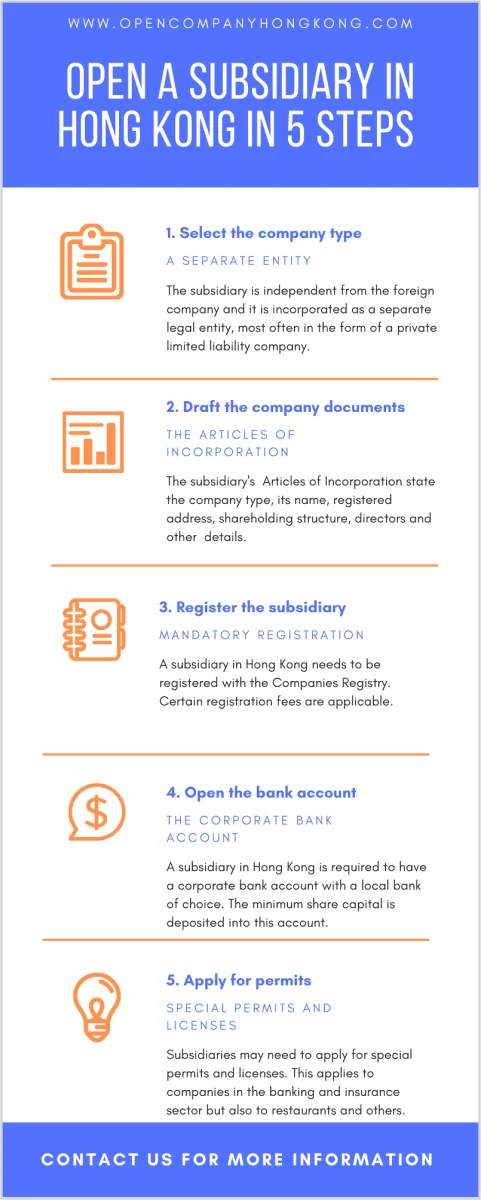
The basic requirements for a subsidiary include:
- at least one director who is a natural person (an individual); a corporate director may be appointed in addition, and directors do not need to be Hong Kong residents;
- at least one shareholder and a maximum of 50 shareholders;
- a company secretary who, if an individual, must ordinarily reside in Hong Kong or, if a body corporate, must have its registered office or a place of business in Hong Kong; a sole director cannot also act as company secretary;
- a registered office address in Hong Kong;
- a significant controllers register, kept at the registered office or another place in Hong Kong and made available to law enforcement officers upon demand;
- an appointed auditor who must be a practising certified public accountant registered with the Accounting and Financial Reporting Council (AFRC).
What are the licensing requirements when establishing a subsidiary in Hong Kong?
Certain special licences could be required, depending on the activity of the subsidiary. Examples of regulated businesses include travel agencies, restaurants, employment agencies, education business, financial services companies, event management companies, certain retail shops (for example those selling food or medicines) or companies trading in controlled goods.
These are just some examples; however, investors interested in company registration in Hong Kong in 2026 for the purpose of starting a subsidiary may need to obtain different types of permits according to the types of activities undertaken by the said subsidiary.
Also, the following licences are generally required, depending on the exact type of activity or activities:
- A licence from the Securities and Futures Commission (SFC) for corporations (and their licensed representatives) carrying on regulated activities such as dealing in or advising on securities or asset management; banks (authorized institutions) carrying on such activities must instead be registered with the SFC as registered institutions.
- A virtual asset trading platform licence from the SFC, required since 1 June 2023 for centralised virtual asset trading platforms operating in Hong Kong or actively marketing their services to Hong Kong investors.
- A stablecoin issuer licence from the Hong Kong Monetary Authority, required since 1 August 2025 for the issuance of fiat-referenced stablecoins in Hong Kong.
- Money lenders licence granted by the Licensing Court; the application is filed with the Registrar of Money Lenders (the Companies Registry), with a copy to the Commissioner of Police.
- Insurance agent licence issued by the Insurance Authority, which has directly licensed insurance intermediaries since 23 September 2019 (before that date, agents were registered with self-regulatory organisations); the licence is needed in order to perform activities as an insurance agent.
- Insurance Business Authorization, issued by the Insurance Authority.
- Licensing of insurance brokers, by the Insurance Authority.
- Pawnbrokers Licence, which is a licence issued by the Hong Kong Police Force.
- Deposit-Taking Company Registration, offered by the Hong Kong Monetary Authority.
- Money service operator licence for remittance agents and money changers, issued by the Customs and Excise Department.
One of our agents who specialize in setting up companies in Hong Kong can give you more information about the financial services licences.
How are subsidiaries taxed in Hong Kong?
Subsidiaries in Hong Kong will be treated the same as local companies in terms of taxation. The corporate tax for a Hong Kong subsidiary is 8.25% on the first HKD 2 million of assessable profits and 16.5% on the remaining amount.
This two-tier regime is advantageous; however, abuses are prevented in the case of groups of companies or related entities. When this is the case, the group may nominate only one of the entities within the group that can apply the two-tier regime. Apart from that, the parent company may also file for certain tax exemptions or credits depending on the double taxation agreement its home country has signed with Hong Kong.
Hong Kong applies a territorial system of taxation: only profits arising in or derived from Hong Kong are subject to profits tax. However, under the foreign-sourced income exemption (FSIE) regime, in force since 1 January 2023 and extended on 1 January 2024, certain foreign-sourced income (dividends, interest, disposal gains and income from intellectual property) received in Hong Kong by an entity of a multinational group is taxable unless the economic substance requirement or other exemption conditions are met.
In addition, for fiscal years beginning on or after 1 January 2025, Hong Kong applies the 15% global minimum tax and the Hong Kong minimum top-up tax (HKMTT) under Pillar Two to multinational groups with annual consolidated revenue of at least EUR 750 million. Subsidiaries of such groups should assess their obligations under the Inland Revenue (Amendment) (Minimum Tax for Multinational Enterprise Groups) Ordinance 2025.
Subsidiaries must also comply with the same accounting regulations as Hong Kong companies. Profits tax returns are generally issued by the Inland Revenue Department on the first working day of April and must be filed within one month of issue (extended deadlines are available for companies represented by a tax representative).
A newly incorporated company usually receives its first profits tax return about 18 months after incorporation. Companies must also file an annual return with the Companies Registry within 42 days after each anniversary of the date of incorporation. The tax year in Hong Kong starts on 1 April and ends on 31 March of the following year; companies may nonetheless choose their own financial year-end.
What are some common mistakes when setting up a subsidiary in Hong Kong?
Appointing the same person as a director and company secretary: A Hong Kong subsidiary must appoint at least one director who is a natural person (who does not need to be a Hong Kong resident) and a company secretary who must ordinarily reside in Hong Kong (or, if a company, must have its registered office or a place of business in Hong Kong). When several directors are appointed, one of them can also act as company secretary, provided the residence requirement is met. If one director is appointed, the secretary must be a different person.
Bank account opening: Each bank has its own document requirements, especially when setting up a corporate account. Asking a few banks for their list of required documents can help you narrow down the search for the perfect bank. However, you can also rely on our local specialists who can help you with recommendations based on your specific needs.
Tax rules: Many subsidiaries are part of company groups, which means they may be subject to tax conditions both in Hong Kong and abroad. However, they can also benefit from various tax exemptions and/or reductions. You can check the applicable rules (including, where relevant, the FSIE and global minimum tax rules) with our accountants before starting operations, so that you are not surprised by the taxes you must pay.
How long does it take to open a subsidiary in Hong Kong?
The procedure can take up to 2 months. This timeframe also includes the bank account opening process. The incorporation itself is quick: for applications filed electronically with the Companies Registry, the Certificate of Incorporation and the Business Registration Certificate are normally issued within 1 hour, or within about 4 working days for paper applications. Most of the time is taken up by preparing and certifying the parent company’s documents and by the bank’s due diligence.
Our company formation consultants in Hong Kong are ready to assist you and answer any questions. Please contact us for additional information.
Susie Hu, Consultant, Tannet Group Limited · 24 November 2026